

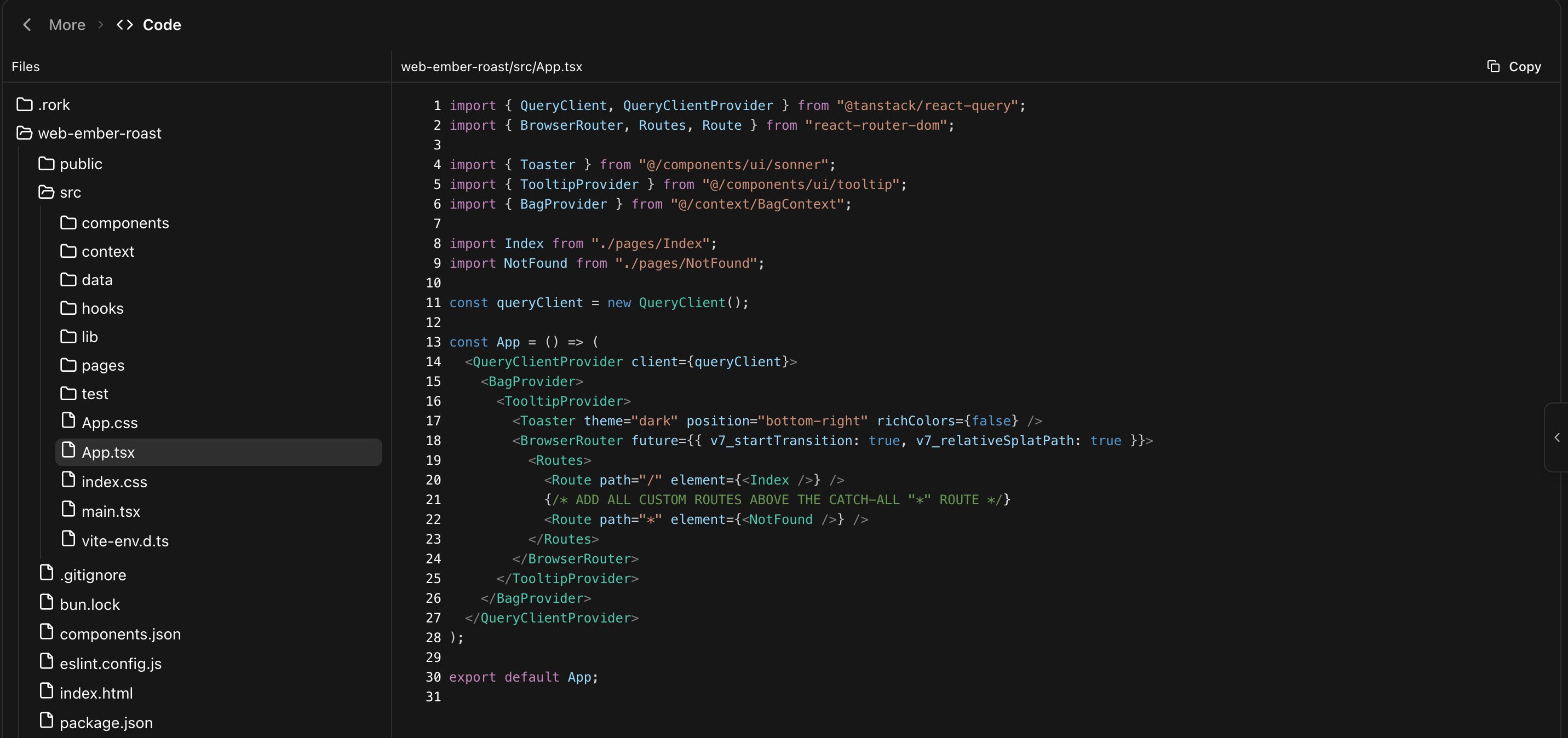
The Code section: the file tree on the left, the file on the right, and Copy in the corner.
- A bug where you want to see what the agent actually wrote.
- A value you want to check, like a price or a piece of copy.
- Handing the project to a developer, so you know what they will get.
- Curiosity, which is how most people end up learning this.
Read the tree
The tree shows one folder per app in the project, so a project with an iPhone app and a web app has two. Inside is an ordinary codebase:src/, components/, pages/, package.json, and the config files a developer expects.
One folder is hidden on purpose. Rork keeps its own bookkeeping in .rork/, and the tree leaves it out, except for .rork/DESIGN.md, the design decisions from Design mode.
Copy in the top corner copies the whole open file, which is the fastest way to paste something into another tool.
Edit by hand
Editing code needs a paid plan. On the free plan the editor shows a banner: “Read-only. Upgrade to a paid plan to edit code.” You can still read every file.
Cmd + S on a Mac or Ctrl + S on Windows saves too.
Two rules to know:
- You cannot save while the agent is working. The header says Project updating… until the turn finishes.
- Rork sees your edit. The next message works from the saved file, not from what it wrote earlier.
Read the logs
The panel at the bottom of the Code section is titled Logs, with a count. It shows what your app printed while it ran in the preview, in real time, tagged by level:[log], [info], [warn], [error], [debug].
Scroll up for older lines, and the panel loads them as you go. The chevron on the right collapses it when you want the whole window for code.
Logs are the fastest way out of a bug the agent cannot see. When something misbehaves without an error dialog, ask for logs first:
Take the code with you
The code in this tab is yours. Connect GitHub and you get it as a normal repository, with one commit per agent turn, which you can clone, run locally, and open in Xcode or Android Studio. See How to sync your project with GitHub and Open your project in Xcode for optional local development.FAQ
Can I edit code on the free plan?
Can I edit code on the free plan?
No. Reading is free, editing needs a paid plan. See Plans & Subscriptions.
Will the agent overwrite my hand edits?
Will the agent overwrite my hand edits?
Not silently. It reads the saved file before it changes anything. Conflicts come from editing the same lines while a turn is running, which is why saving is blocked during a turn.
Where is the .rork folder?
Where is the .rork folder?
Hidden from the tree, because it is Rork’s own bookkeeping.
.rork/DESIGN.md stays visible.Is there a search across files?
Is there a search across files?
Not in this tab. Ask the agent instead: “which file sets the free delivery threshold?”.
The Logs panel is empty.
The Logs panel is empty.
It says “No logs yet. Logs from your app will appear here.” Interact with the preview, and anything your app prints will arrive.
Can I run the project on my own machine?
Can I run the project on my own machine?
Yes. Export to GitHub, then run it like any Vite, Swift, or Kotlin project.
Next steps
Sync with GitHub
Get the code into your own repository.
Undo and history
Review the diff of any change the agent made.
Get out of an error loop
Use logs to break a cycle of failed fixes.
Keys and secrets
Why keys do not belong in the code you just opened.