You can no longer create Expo (React Native) projects in Rork. New apps are native iPhone (Swift), native Android (Kotlin), or web. If you already have an Expo project, it keeps working: you can build it, publish it, and export the code to GitHub as before.
Why we switched
On our internal benchmarks, the agent wrote better Swift apps than React Native apps. That is why we switched.
New iPhone apps are Swift. New Android apps are Kotlin. New web apps are React. Expo is still a real native stack, and many production apps ship that way.
Two native apps, one project
React Native shares one JavaScript codebase across iOS and Android. That is a real engineering advantage.
Rork does not keep that model. An iPhone app and an Android app are two separate native apps. What stays shared is the product around them.
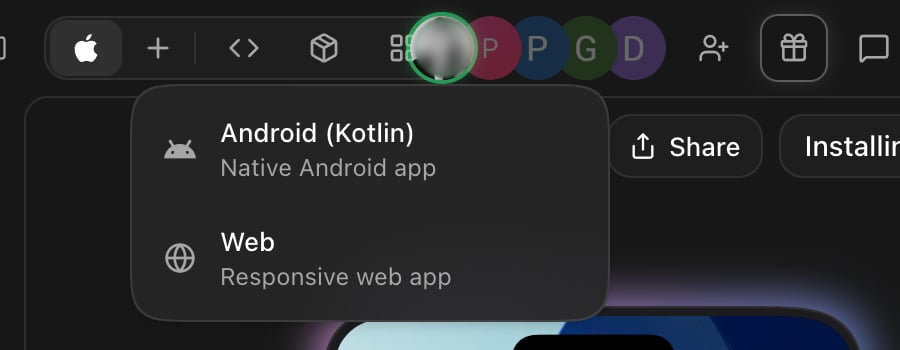
Build for one platform first, then add the next one. Click + above the preview and pick the platform:
The agent recreates your screens, navigation, data flows, and design in the new app. Both apps then live in one project, with:
- Two codebases. Swift for iPhone, Kotlin for Android. They are not one shared file.
- One hosted backend. If the project has Rork Cloud or Supabase, both apps talk to the same database.
- One chat and one context. The agent knows your whole product, so “add dark mode to both iOS and Android” can update each app.
- One place to publish. App Store, Google Play, and the web, from the same Publish menu.
The two apps can still drift. A Swift change is not the same file as a Kotlin change. The agent is how you keep them in sync. That is different from one shared React Native codebase.
I already have an Expo project
It keeps working: you can build it, publish it, and sync it to GitHub as before.
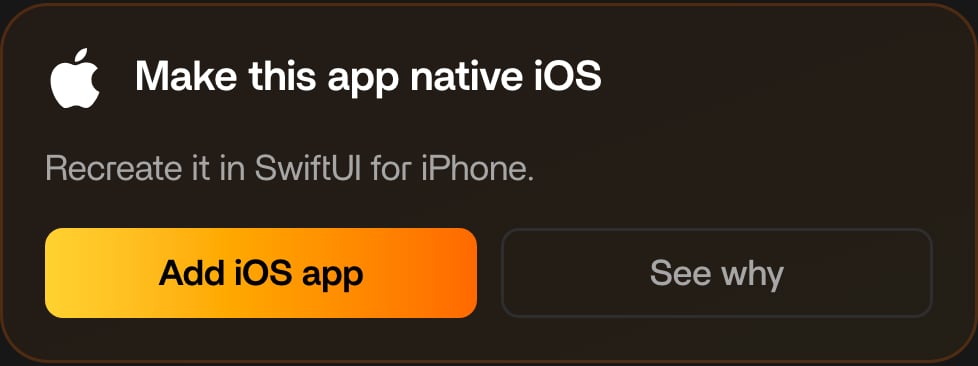
We strongly recommend moving it to Swift. Open your Expo project and look at the panel next to the preview. Rork offers to rebuild the app in SwiftUI for you:
Click Add iOS app and the agent recreates your screens, navigation, data flows, and design as a native iPhone app in Swift. Your Expo app stays untouched in the same project, so nothing is lost if you want to compare them.
For Android, add the native app the same way: click + above the preview and pick Android (Kotlin), or ask in chat:
Both new apps live in the same project as your Expo app, sharing the backend and the chat, so you can move over one platform at a time.
Not sure which platform to start with? See iPhone, Android, or web: what’s the difference, and Convert your app between iOS, Android, and web for every path between platforms.